Showing posts with label prejudice. Show all posts

Friday, 23 May 2014

Budget grumbles -1. Media

It's Interesting that after the disastrous budget, the Murdoch media is currently working overtime to vilify students and disability pensioners, and whilst it makes a welcome change from the prejudice directed towards asylum seekers and the lies surrounding their issues, it's no less repugnant. They are however providing a wonderfully rich resource for teachers, particularly those working with English, clear thinking, logic, media and even maths students. 
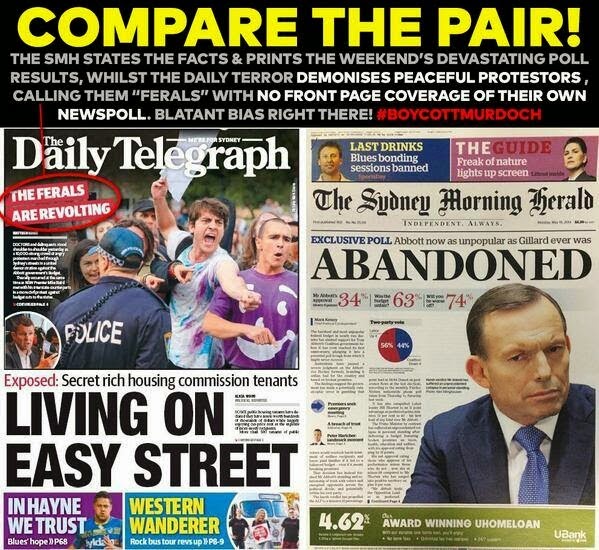
The ferals are revolting

There is no room for misunderstanding the reaction expected of the reader, who is now primed to agree and demonise those who are protesting, without having any idea who they are or what they're protesting about.

The Daily Telegraph directs us to focus on a small group of presumably angry protesters and a prominent policeman. Did the photographer or some other person encourage the people to point dramatically? Is the policeman placed there to remind us that ferals need to be kept in their place? A quiet, orderly protest isn't nearly as dramatic as one with "action". 

One wonders how the picture has been cropped. Who was to the right of the person in purple? Was it someone older who’d benefitted from the free education enjoyed by many of the Prime Ministers generation and who believes that a well resourced and equitable education system, available to the whole population, makes for a strong and vibrant society? Was it a man under 30 living in an area of high unemployment, wondering how he'll support his family if he's laid off. 6 months without unemployment benefits is a long time. What has been cropped is just as important as what has been highlighted.

The huge headline LIVING ON EASY STREET is dramatically placed under the action shot of people pointing.  A cursory glance would imply that living on easy street refers to those vile and scary 'ferals' - it doesn't, and is completely unrelated. Nothing about the disastrous poll, nothing prominent about the diverse and valid reasons for the protests. No insight provided for curious readers.

In contrast, note the almost sombre tone of the Sydney Morning Herald where poll results are placed prominently, reflecting the strong and angry reaction by ordinary, everyday Australians to the budget. Further information is provided for those choosing to delve further. 

Everyday Australians targeted
For some details about how ordinary, everyday Australians, our neighbours, and others in our communities will be affected by this unfair budget look here. There you'll find some of the figures that which are usually shared openly on budget night. 
More than one third of the budget cuts - $6 billion - fall on the middle quintile of households, earning $45,000 to $63,000. 
■ Families with school-age children are the hardest hit. Across all income groups, they will lose $15.9 billion over four years, more than 90 per cent of the total. 
■ Low and middle-income sole parents suffer worst of all, losing between 10 and 15 per cent of their annual income - $4000 to $6250 - on family earnings of less than $60,000 by the time the changes to welfare take full effect in 2017-18. 
■ The burden rises sharply for families with children over the four years of the budget. For example, a sole parent earning $60,000 with children aged eight and 12 will lose $1808 in annual income in 2014-15 and $6278 in 2017-18. 
Low- and middle-income earners, especially those with school-age children, are hit hardest as the family tax benefit for single-income families is abolished and indexation is curbed. 
And that's fair? To target low and middle income earners yet not the wealthy?


...


The Daily Telegraph ran a front-page story about there being more people on disability in NSW than died during the World Wars. 

In what way is this relevant? In what sad world is encouraging readers to further marginalise and sneer at disability pensioners, rather than show compassion and understanding  considered acceptable?

Apart from them apparently running the same divisive line a few years ago, they chose a picture of a long queue of people appearing to line up to receive their disability payments. Placed carefully next to a picture of diggers we're encouraged to agree - Diggers did it tough. They suffered. Disability pensioners aren't as worthy as them. 

It turns out this photo is a fairly common piece of royalty-free stock imagery. A Google image search finds this and this and this. It's not related to real Australians on pensions.
But it's too easy to just cruelly vilify those on disability support, and imply that they're bludgers rather than give accurate, reasoned and intelligent insight into the real issues. There's a more thorough assessment here.

This kind of manipulation appears designed to influence and deflect the anger so many feel against the cruel budget. It's a blatant attempt to discredit our fellow citizens who have genuine concerns about how they'll manage with a variety of cuts and persistently increasing costs. These tactics target those least able to respond, and look like a smelly smokescreen to take people's minds off the real issues of inequity, unfairness and a wider gap between the have's and have not's that will be the outcome of the budget . 

AXE THE TAX


Is everybody really being asked to help with the heavy lifting?

Who isn't being supported by this budget? What happened to the end of the age of entitlement?

Is the government able to maturely handle the anger directed at them in response to their unfair budget? Do they need the Murdoch press to shield them by pointing the manipulative finger of outrage towards those negatively affected? (rhetorical question) 

When mining companies were threatened with a fair tax, they used their extraordinary financial resources and complained loud and long. Why is it ok for exceptionally profitable, multinational mining companies to protest, yet not ordinary Australian citizens? Is anyone in government able to explain, without resorting to predetermined cliches, why those least able to pay are being hit hardest, while those most able are barely touched? (another rhetorical question)

to be continued... here Budget Grumbles 2. Education and unemployment.


.


Monday, 22 July 2013

What are the downsides of a QANTAS stopover in Dubai, UAE?

(Trigger warning - rape)
Safety signs are everywhere, at theatres where strobe lights are being used, at amusement parks, where some rides are unsafe for people below a certain height, at playgrounds and in shopping centres. They're bright, obvious and sometimes seem a bit over the top with stating the obvious:
But what they all have in common is the perceived need to keep the public safe ... and possibly the venue from being sued!
Some are clearly designed to inform the travelling public of potentially dangerous local conditions, and are very welcome for those not used to such things as wandering bears in camping grounds:

However, when it comes to overseas travel, information about dangers aren't always as well publicised or easily accessible. A vague, generalised comment might appear on the home page of an airline website about potential difficulties when travelling to specific countries, and even the "Summary" about a country in the government travel website might not mention some important information.

Recently, QANTAS airlines has partnered with Emirates, and all flights to the UK now pass through Dubai. It's being presented not only by the airlines, but by travel agents in Australia, as a wonderful place to break your long journey by a few days or more.

Easily accessible QANTAS information about Local Culture in Dubai includes:
Respect: Travellers to Dubai should always remember to respect local laws and traditions. Alcohol is only served at licensed establishments and people should dress and behave with modesty during their stay.
There is no link to further information such as: http://www.smartraveller.gov.au/zw-cgi/view/Advice/?topic=United_Arab_Emirates where we see the following:

Exercise a high degree of caution
This alerts the traveller to read further.

Given the extremely restrictive laws and harsh penalties for many things perfectly acceptable in Australia, wouldn't it be responsible for both QANTAS and Emirates to direct passengers reliable and comprehensive information so that they don't end up in jail where the Australian Government will have little ability to assist?

What the brochures don't tell you:
Alcohol is served in bars and clubs at most major hotels but may only be consumed by hotel guests. Residents are not allowed to drink in hotels unless they hold a liquor licence. The legal age for alcohol consumption by licence holders in the UAE is 18 years of age, though a Ministry of Tourism by-law requires hotels to serve alcohol only to those over 21 years. Drinking in public or being intoxicated in a public place is illegal and offenders may be arrested. Foreigners have also been arrested on arrival in the UAE after becoming intoxicated on incoming aircraft or while in transit. 
Imagine that you and your friends are staying in different hotels and that you've had a few drinks together. It's not unheard of for a group of Aussies to have a few too many drinks before finding a taxi back to their own hotel! Given the lack of information on the QANTAS website they'd be unaware that:
Visitors to the UAE should also be aware of incidents arising from the use of taxis where passengers are intoxicated. Any dispute with the driver may result in the passengers being taken directly to the police station and charged with public intoxication.
No doubt QANTAS was aware of these laws before encouraging Australians (who are known to enjoy a drink) to visit. What were they thinking?

Would any Australian reading the extremely superficial cultural information on the QANTAS website realise that if they do happen to be arrested for being drunk that:
If you are arrested or jailed, the Australian Government will do what it can to help you but we can't get you out of trouble or out of jail. Any custodial sentences will be served in local jails. (smarttraveller.gov.au)
We're used to being warned about potential dangers, and safety reminders are often welcome. Here is a very real danger, yet the warning about the possibility of a jail sentence after having a night on the town while on holiday is not obvious.

But it's not just the danger of having a few drinks too many, are you aware that:
Medications available over the counter or by prescription in Australia may be illegal in the UAE.
If you're travelling to the UAE, do you know where to go to find which medications are deemed illegal? Can your travel agent direct you to the information?

The crime of being the victim of rape
Did you also know that if you're unfortunate enough to be raped in the United Arab Emirates that you should not report the crime to the authorities?

Did you also know that if you're raped by one, or a multitude of men, that if you're injured and need medical attention, that you shouldn't seek medical assistance until you've first contacted your Embassy?

Did you also know that if you're employed by some companies in the United Arab Emirates and are raped, that it's best not to tell them or you could end up with the additional stress of being fired.

Unfortunately these and other horror stories aren't isolated examples. Yet this is the country that QANTAS is now funnelling unwary Australian tourists through on their way to the UK and in which travel agents are encouraging stopovers.

Helpful information about the potential danger of travel to the UAE is tucked away in the Australian government travel website www.smarttraveller.gov.au, rarely read beyond a cursory glance by the novice traveller because, understandably, being jailed for being raped is a possibility that hasn't been considered. A victim of rape would naively assume that seeking medical help would be safe and they certainly wouldn't think that if they'd been violently abused, that seeking necessary medical attention would result in being charged with "having sex outside marriage" and ending up being held in custody, with your passport confiscated and not allowed to make a phone call for assistance.

Being jailed for being raped has been reported about at least two young women, one an Australian who was jailed for 8 months for the "crime", the other a young Norwegian who will be in jail for 16 months on charges including being raped.

The UAE with its vastly different expectations of behaviour and brutal attitudes towards women and sexuality, is "set to be one of the hottest destinations from Australia in 2013" (QANTAS website)  where even our Embassy may be unable to assist if you're the victim of rape and have been charged with that "crime".
Victims of sexual assault: It is possible that victims of sexual assault may be charged by UAE authorities for engaging in sex outside of marriage and be dealt with according to the criminal law. There have been cases in the UAE where sexual assault victims have been imprisoned after reporting an incident to local police or upon seeking medical assistance. Sexual assault victims should contact the Australian Embassy in Abu Dhabi or Consulate-General in Dubai, or the Consular Emergency Centre in Canberra, as quickly as possible to obtain relevant information on these issues and guidance on what support services may be available. Consular officers cannot provide legal or medical advice but can provide lists of English-speaking service providers who may be able to assist you in this process. Contact details are listed under Where to get help.

Note the use of the word "may" - it's not clear that there are support services or that they will be able to assist. 

All women, but particularly young, unmarried women need to be extremely careful when travelling in the UAE - even if it's just a stopover. Drink spiking happens - you will be blamed if you're the victim of sexual abuse and could well end up in jail. Is it worth it?

Good one QANTAS - more young women will now be exposed to this vile attitude towards women and rape and a culture which appears to condone the abuse and jails the victim. A culture where women are less than second class citizens. I have the horrible feeling that these two publicised cases aren't going to be the last.

Thinking about ethics as I often do, I'd be uncomfortable promoting Dubai as a stopover for men or women without encouraging them to read the extended DFAT website thoroughly. It's relatively easy to search for information about being drunk (a crime), holding hands (a crime) and even the crime of looking at local women (another crime), (here) but it's not on the QANTAS website and there is no link or even the hint that you need to understand local customs in far more detail than one would normally expect. The issue of rape is not surprisingly, avoided or ignored expect on the DFAT website.

Jewish Australians 
If you're a Jewish Australian, forget it, it's possible you may not be allowed to leave the airport, although that's unclear (here) - which could be a blessing in disguise! It's certainly not clear from information provided by QANTAS. Good one QANTAS for supporting discrimination. But what happens if lots of aircraft are grounded and airport hotels are full? Where do our Jewish friends go? If they're not allowed to leave the airport - will they be forced to sleep on the floor in the transit lounge?

Do travel agents remember to ask all travellers? Do they remind travellers to get a new passport if they've travelled to Israel? Do they give clear information about who to contact and NOT to contact in the case of emergencies and why this is vital? Can they direct travellers to information about local laws?

GLBT and defacto couples
Not only will there be a clash of cultures with attitudes towards drinking and holding hands in public, but sex outside marriage is illegal and you may be asked to prove that you're married. I wonder how many Australian couples are made aware of this before travelling? What does QANTAS suggest they do?
Homosexual acts and sex outside of marriage: Homosexual acts and all kinds of sex outside of marriage are illegal and may lead to severe punishment, including imprisonment and fines. Foreigners have been imprisoned for having sex with people to whom they are not legally married. De facto relationships and civil unions are not recognised in the UAE and any sexual acts within these relationships are considered to be sex outside of marriage. It is also against the law in the UAE to live together or share the same hotel room with someone of the opposite sex to whom you are not married or closely related. If checking into a hotel as a couple, you may be asked by management to prove that you are legally married. These laws apply equally to UAE residents as well as visitors.
QANTAS, I won't be staying in Dubai, and I'll discourage everyone I know - I refuse to support a country which openly condones violence towards women and blatant discrimination towards fellow Australians. You haven't provided clear information or obvious links to smarttravellergov.au and appear not to have thought through the implications of your partnership with Emirates, not only on your own staff, but on Australian tourists.

Tourists could understandable be forgiven for assuming that if Australia's trusted airline QANTAS and their travel agents are encouraging a visit to the UAE, that the country is relatively safe. Given the warnings on the Australian Government travel website, that is a questionable assumption.

Travellers need much more than a superficial "be careful, they have different laws there". That is such a vague statement as to be meaningless for the unwary, inexperienced traveller who knows nothing about Sharia law. The sign at the start of this post about bears is more helpful. It's clear the situation and danger is taken seriously and the traveller is appropriately warned about the danger which could be experienced. You are able to make an informed decision before staying.

Lift your game QANTAS and Emirates and give the travelling public adequate information about the "hottest destination for 2013" so they can make a fully informed decision about whether they choose to visit or not.

Racism
For anyone who wants to use this a platform for racism think very carefully about blanket assumptions about any group which has repressive attitudes towards alcohol, women and sexuality. Right wing, fundamentalist men in many religions including Christianity and Judaism as well as Islam have more similarities than differences in this regard.

So called christian men in the US and Australia profess very similar brutal attitudes towards women and are keen to impose repressive, backwards ideas onto the rest of us. Some make laws about what women can and cannot do regarding pregnancy, others are determined to impose their creationist views and disregard for science onto schools. In Australia, men have used their position as priests to sexually abuse children and have systematically, knowingly and deliberately covered up the crimes.

All countries have their share of both progressive and fundamentalist groups - thankfully, so far in Australia they haven't managed to gain as much power as those who make the laws in the UAE.

Let's keep it that way.

........
https://www.facebook.com/smartraveller.gov.au

http://www.smartraveller.gov.au/zw-cgi/view/Advice/United_Arab_Emirates

http://www.qantas.com.au/travel/airlines/flights-dubai/global/en#local-culture

http://travelinsider.qantas.com.au/a_date_with_dubai_travel_city_guide.htm

http://www.smh.com.au/travel/travel-news/dont-kiss-dont-swear-rules-of-a-dubai-stopover-20130326-2grsc.html

http://www.smh.com.au/travel/travel-news/get-to-grips-only-with-rules-on-dubai-transit-20130323-2gmef.html

http://www.news.com.au/travel/travel-advisor/qantas-answers-questions-on-emirates-deal/story-e6frfqfr-1226609581728

http://www.jewishnews.net.au/qantas-no-need-to-fly-via-dubai/27830


.
Wednesday, 4 January 2012

Would you give your car keys to a stranger?

I was at a barbeque just before Christmas when the conversation got around to phone scams and how each of us manage the calls.

You know the calls I'm referring to. The phone rings and you're greeted by someone with a heavy accent, and it goes along the lines of "Are you (insert name here) of (insert phone number here)?" They may even mention your suburb.

If you've distracted and aren't really paying attention, you might thoughtlessly confirm the details.

The standard spiel continues along the following lines: "I'm calling on behalf of Microsoft to let you know there's been a serious issue reported with your windows programme.  I'm from X company and need to perform an immediate mainteance check to ensure the problem doesn't happen again."

They're full of tech talk and use words designed to bewilder and confuse the average computer user, but most of all they're working hard to make you worried that all is not well with your computer, and are insistent that this needs to be fixed NOW! The caller is insistent, persuasive and convincing.  They use phrases like "corrupt files", "viruses" and "error code".

They create a sense of panic.

Reports of this particular scam have come in from London to Brisbane, New York to Christchurch and most places in-between. Far too many people have been caught on the hop; the figures are sketchy due to many people being too embarrassed to report the theft once they realise they've been taken in by scammers.
from "The Little Black Book of Scams" - Australian Competition & Consumer Commission
They've been gullible, trusting or naive or maybe ill, elderly or confused and followed the instructions thus enabling the scammer to instal viruses and spyware on their computers. The scammers could be using payphones or disposable cell phones, so they're well nigh impossible to catch even if you get a number and report them.  The victim may have paid for 'Life Time Support' by PayPal, credit card, or given bank details, thus enabling accounts to be emptied as they sit and watch.

Each of us sitting round the table had had up to 10 calls a week over a period of a couple of weeks - the calls stop for a while, then start up again. The calls are invasive, irritating and time consuming.

They've been known to leave some people feeling that their privacy has been invaded, and if the scammer has become abusive, people can be left feeling insecure and rattled.  This is the reaction of people who haven't succumbed to the scam.  If you had lost money and thought the scammer could appear at your front door, you'd be sick with fear and apprehension.

The conversation got around to musing if there could be some sort of a link between anger towards Indian students in Melbourne and other Australian cities, and anger about the scam. Could someone with a short fuse, who has perhaps been "got" or who knows someone who has lost money and peace of mind, react physically? Might some people target an unsuspecting student who appears to be of the same ethnicity as the scammer? We have no idea, but it's possible.

We put our heads together to try and come up with some different ways to use the experience as a chance to do something worthwhile. Amongst other things, we decided we wanted to express our concern to the scammer about the possible repercussions to foreign students in Australia as a direct result of their scam.

Being rude - nope.

Appeal to the scammers better nature - no.

"I'm recording you" - a recording could be used as an instructional tape so people know what to listen for. Could be useful.

Putting the phone of speaker so your children can listen - discuss how language can be used to persuade - good!

Tell the caller you're expecting a call from their Embassy to discuss scams. Could work.

Ask them if they believe in Karma - remind them of the repercussions of their actions. Seems to work.

Most recently though, I've decided simply to say "This scam has a direct impact on students living in Australia. Your action makes them unsafe and encourages racism." This seems to work although it needs to be refined so the word scam comes later - strangely they usually hang up when they hear the word scam. I'm probably tempting fate here, but since using that one, the calls have tapered off significantly.

If you have been caught off guard and given the scammer access to your computer: Disconnect immediately, phone your bank to alert them to what's happened and cancel your credit card, and as your bank statements come in, check them carefully. Contact a reputable company, (trusted friends and neighbours are a good source of information) let them know what's happened and they'll remove any malware that's been installed.

How do you manage scammers? Do you hang up immediately, are you rude, do you play along for entertainment value or have you devised a wonderfully creative response?

More information on scams:

  • The Microsoft scam page information is here
  • Information on how to recognise different kinds of scams is here
  • An A-Z of fraud is here
  • A Police warning about the above scam is here
  • The Little Black Book of Scams can be downloaded for free from the Australian Competition and Consumer Commission here
  • ... and I'm sure there are many, many more links and that this is just the tip of a massive scammy iceberg.


The title of this piece came from a forum where someone asked "Would you give your car keys to a stranger? That's the equivalent of what you're doing if you allow a stranger access to your computer."

.

Thursday, 4 August 2011

Why are people rude?

What does your private communication with your followers or clients say about you?

I’m going to confess to two scenarios where I made an error when referring to someone hosting a blogging challenge. No big deal you might think, but it got me thinking ...

The first: I published a post where I got the gender of someone hosting a blog challenge incorrect.

The second: via email, where I referred to a co-host of a blog challenge incorrectly, using their last name as if it was the first name.

In the first instance, the error was tactfully brought to my attention and fixed promptly.

In the second, the return email inferred that I was not only lazy in not checking the order of the first and last names more carefully and bluntly stated that I was not giving the co-host the attention they deserved.

In the first instance I felt I was seen as a human being with failings that were accepted. It could also have been acknowledgement that ‘people get my first and last names mixed up all the time’, or even, ‘silly woman, didn’t she see the very masculine photo on my blog, it’s obvious I’m not female!’ I felt a bit silly, but it was all fixed with a minimum of fuss.

In the second instance the message was that I’m a sloppy, careless person who shows a lack of respect. I can apologise of course, but at the moment feel that further communication isn’t going to achieve much - I feel that I have been judged and found to be inadequate.

I then began reflecting on the reasons people make ‘mistakes’ that may on first glance appear to be careless and how in all our communication we reflect aspects of ourselves, which can sometimes be misconstrued.

But deeper than that, the response got me thinking about my personal work and how I respond to emails and phone calls. Am I generous in my dealings with clients? Do I give them the attention they deserve?

Of course many of us are time poor. Life gets pretty busy with work, family, friends, blogging and all the complexities of life. Sometimes we aren’t as careful as might be ideal, but if added to that was the pressure to be perfect in our communication, would we get anything done? Do I respect this when I receive an awkwardly worded email?

I'm slightly dyslexic, and don't always notice errors of reversals and misspellings. Am I tolerant of misspellings by others?

How does living with chronic pain affect your communication? If you’re recovering from a medical procedure, and the after effects of an anaesthetic, how does that affect your ability to communicate, and the way others perceive you?

People live with ADD, ADHD; there are connections in the brain and body that make concentration difficult, even alien. Many people who communicate with us are functioning as best they can, some will be suffering the effects of low or fragile self-esteem, having been bullied at home or work. How does this sound in an email or tentative phone call? Do I remember to 'read between the lines'?

How much courage does it take for someone to make the first tentative step to call for an appointment? If it’s taken 6 months, could my response set them back even further, perhaps never to seek help again?

Do I judge before I think? 

And perhaps equally as important, do I allow myself to make mistakes, or do I bully myself for being less than perfect?

It's always interesting to see where thoughts lead - I'm almost grateful for what at first seemed an inconsiderate, rude and condescending email.

Q: What do you think? Has illness or some other life event affected how you communicate? How have others responded to you?


**I'll be away for a few weeks in China, and due to their restrictions will be unable to access Blogger or post replies. I look forward to catching up with you all when I return.

I've shared a couple of photos of Macau over at jumping aground - link here.

.

Friday, 1 July 2011

The Transformers Choir & the power of music to heal.


Songwriting as a tool to process grief.

Dr Felicity Baker at the Happiness and its Causes conference discussed research into the power of music which showed that listening to music helps people who have had strokes improve their cognition and ability to think. She also discussed the therapeutic value of songwriting as a tool to help process grief as well as joy.

It’s like telling healing stories in a musical way. 

We heard in a panel discussion that musicians are sensitive souls who need to understand the depth of human emotions to be able to express them through song and music.

“It’s a gift to be able to move people to tears. Musicians are sensitive souls and need to understand emotion and to share, to be vulnerable in front of an audience for a living, to lay oneself bare, for the emotions to be bare, as a gift to the audience”.


The Transformers Choir
The Transformers are a group who experience extreme disadvantage in their communities and may experience mental health problems, general disability and homelessness in inner city Brisbane. Nonetheless they rehearse weekly and perform regularly. Their motto is a quote from Hans Christian Andersen: “Where words fail, music speaks”.
Transformers Choir - pic from here
The goal in creating the Transformers Choir was to bring people together as part of a community, to connect with others and let music do its magic. Creating music added a new focus to their lives. Participating in the group has given meaning to many and some group members say they feel less depressed. Apparently focusing on creativity in one sphere of our lives can encourage us to be creative in how we deal with ourselves in other areas.

The Transformer’s songwriter Brian Procopis, listens carefully to group members and collaborates fully with the contributors, it’s their experience he’s writing about, not his, and he’s very respectful of this. The bad stuff in life isn’t ignored or denied, and is incorporated into song, but the primary focus is on creativity and the process of writing the song. This was a really powerful illustration of the therapeutic effect of music and song that Dr Felicity Baker mentioned.

So much to think about. I’m in awe of the courage it must take to perform on stage when you are vulnerable, not only as a musician but as a member of a group disengaged from mainstream society.

This comment moved me deeply:  “The Transformers want to be inspirational and give to the audience”.

There we were, a privileged audience, consisting of professional, medical, creative, religious, artistic, and generally well to do people, being offered a gift from those who have little to give, expect themselves, their voices and their experiences.

It's really the greatest gift of all isn't it, to give yourself. Not a thing, not something with a dollar value, but yourself. They have nothing, but they gave everything.

I felt gratitude, but also humbled, privileged, honoured, energised, uplifted, and moved to tears.

They received a standing ovation.


***

Creativity. Music. Curiosity. 
A great combination to begin the healing process after bullying.


Given what we now know about the power of song-writing to aid healing, it'd be great if those who have been the targets of bullying, and are hurting in other ways, could have a go at writing about your experience in song and perhaps make up a tune for it. Or if that's a bit too daunting to start with, try singing a song perhaps while washing the dishes.  See what happens. Be inspired by the very obvious benefits the Transformers experience and see how it pans out in your life.

Articles about the Transformers Choir here and here.
.

Tuesday, 26 April 2011

V. Vulnerable. Workplace bullying

This post is for the letter V in the A-Z blogging challenge 2011. 

Vulnerable: Exposed to the possibility of being harmed physically or emotionally, susceptible to attack.  The bully will home in on those who they perceive as being vulnerable in some way.

There are many and varied reasons why targets are vulnerable; they may include one or more of the following:
  • being alone in the world
  • being seen as 'brainy'
  • being a caring person
  • having caring responsibilities at home, being primary carer
  • having a disability or perceived disability
  • dressing differently or being unable to afford modern clothing
  • choosing not to join in with drinks after work
  • strong sense of fair play
  • feel guilt quickly
  • being scrupulously honest
  • suffering an illness, or taking time off to be with an ill family member
  • having integrity which you are unwilling to compromise 
  • suffering an injury
  • having a learning difficulty 
  • being unable to change jobs, limited job opportunities, being a specialist
  • belonging to a minority group, with a different religion and culture
  • having no other means of support
  • the need to pay the mortgage
  • very reasonable
  • being a single parent
  • being a student
  • being unsure of yourself
Graffiti art on the side of a building in Berlin. 2009.
If you are being targeted by a bully, it's valuable to have a support network who validate your experience and don't brush your concerns aside. Professional people who have expertise in the area, as well as family, friends or colleagues can support you if you choose to stay and fight the bully, or  decide to look for another job. (See Y: You can do something)


Here tomorrow: Why me?


There are many outstanding resources on line. A couple I find useful are Bullying. No way! an Australian resource for teachers and students, and a UK site Bully On Line. The Facebook group eBossWatch here regularly posts articles and links to current issues on bullying. This is in no way an exhaustive list, and each country will no doubt have equally good or more relevant websites. If you're being bullied please seek advice from a professional health care practitioner experienced in this area.

Over at jumpingaground I'm spending the month Drabbling using alliteration, many with an environmental theme.
.

Sunday, 15 August 2010

Racism, intolerance and prejudice?

Ethical workplaces. Ethical co-workers. Ethical behaviour. Simple enough isn't it?

So many of the people I work with want to behave ethically and with integrity, and yet feel pressured into putting their own deeply held values aside when they enter their workplace.

This leads to extreme tension for many people, and impacts on their psychological, and often their physical health.

I was working with a University leturer recently who confessed that what he perceives as a lack of ethical behaviour at his university is making him seriously consider resigning from his prestigious post.

You see, in his university, English language standards for international students (who will remain in Australia on completion of their degree) are apparently being bypassed or ignored.

To be enrolled the students are supposed to have English language of a satisfactory standard to complete their course. They are expected to have sat, and passed, an exam to ensure they will understand lectures, course notes and reading lists. The English language exam is also meant to indicate their ability to be able to produce satisfactory written and oral work.

Where does this go wrong?

This lecturer has been accused to being racist for pointing out that if a student is unable to complete the requirements to the University standard, then the student should fail.

Sure we can and do teach requirements for the presentation of their reports complete with referencing and bibliographies. His university also offers bridging English courses for students who may need them. Fair enough, that’s how it should be.

But somewhere along the line some students are being passed who don’t have the required English skills to, for instance, write a report independently, read (and understand) Warning labels on bottles, or adequately understand mathematical questions. (This is naturally of great concern when some of these students will work in the medical field, and has a negative ripple-on effect in those workplaces).

This post isn’t about the rights or wrongs of the system per se, but about the effect of name calling, and being required to compromise your own standards. It’s about the effect of this on an individual employee. (I'll talk about the effect on the students in another post).

Simplistically it boils down to - pass the students, or have your hours reduced. And the effect is an uncomfortable dilemma. Do you pass students who aren't up to scratch, or fail them and not make your mortgage repayments?

Unfortunately this is all too common an occurrence. I regularly work with academics, teachers and administrative staff who are deeply distressed about having to compromise their values; to be pressured into passing students whose work is sub-standard.

Some leave, some stay and struggle on, disillusioned and unhappy. Being an onlooker, I do wish that someone; someone in a position of power would acknowledge the damage that is being caused, (not just to my clients, but to the students and their future employers) and have the courage to say “This is wrong. The buck stops here. I will address this issue.”

But I'm not holding my breath.


***