Showing posts with label China. Show all posts

Tuesday, 25 August 2015

Part S - Teaching in China - Shanghai

It’s a sobering experience to have spent more than 4 hours flying across the vast and mostly empty interior of Australia with its approximately 23 million people clinging to a few pockets on the perimeter, only to spend the last few minutes of the 12 hour flight peering down at Shanghai with more than 24 million people in just the one city.

I don't know Shanghai well, but I enjoy visiting. Over the years, I’ve walked along a few streets, I’ve taken a few taxi rides, been on a couple of subway trips. Given the size and density of the city, that’s as insubstantial as someone making an assessment of Australia based on perfect Spring day in Sydney and concluding that no place could be finer!


One year, we stayed at a small hotel in the French Concession and enjoyed walking ... and walking, and walking. Wandering down alleys, peering between fence palings, oohing and aahing at statues. 
As a tourist, I find this area enticing. The generous tree lined streets provide welcome shade and a sense of coolness in the hot, humid summer heat, and while some areas are busy with crowds of people, others encourage you to pause and reflect on the rapidly changing country. 


Shanghai is a living city, with children heading off to school, university students and exchange students milling around with backpacks and take away coffee. Men of varying nationalities in suits, striding purposefully to offices. Others gliding along on bicycles, seemingly oblivious to the traffic, threading through cars and electric motor bikes with apparently no care in the world!

Chubby middle aged men stripped to the waist, some only wearing boxer shorts, sitting on upturned boxes, or with their singlets or t-shirts rolled up to below their armpits to allow their sweat to evaporate in any hint of breeze. Beautifully made up women, slender and haughtily confident of their superiority, clip along in sparkly stilettos and short, figure hugging outfits. 

Older people stroll to get the morning paper, some with small dogs with little booties. Washing hanging on poles jutting from windows in narrow, homey alleyways. 

In parks, in singles and groups, people exercising in the mornings - various kinds of dance, tai-chi, games similar to badminton - all part and parcel of a city so different, but somehow vaguely similar to Melbourne. Maybe it's something to do with the plane trees and the Chinese having been part of the Australian population since the early days. 

Here, as in Melbourne, you're just a face in the crowd, no different to millions of others. It's very different to teaching off the tourist track, where it's obvious many people haven't seen, let alone spoken with people from English speaking backgrounds before, where your every move is cause for curiosity and staring.
Hoardings and living green walls hide construction sites and the crowded relocatable housing for workers who've been attracted to work in the big city. Living conditions are as varied as in any large city, and dust covers the valiant efforts to dry washing on a line outside a hut. The amount of construction is incredible, cranes appear like a giant game of pick-up-sticks, scattered around the huge city. It's a riot of colour, movement and sound.

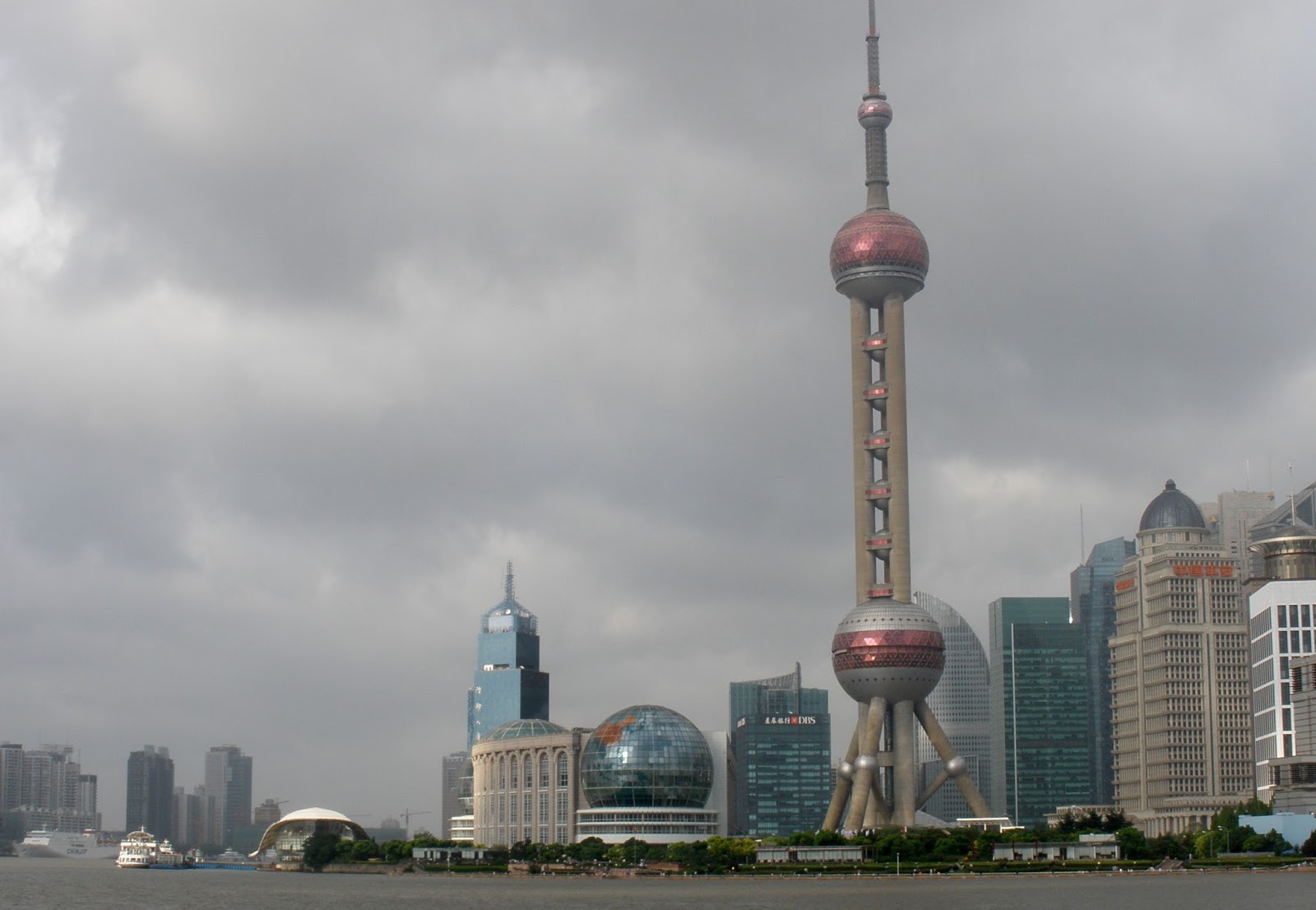
Shanghai is a city gripped by modernisation, and the pace of the change is breathtaking. On my first visit in 1978 it was like visiting a city with solid roots to the past. Those roots are still there in the lively alleys and the stately old buildings contrasting with the futuristic gravity-defying new ones. 


Not everything relating to the past has been discarded, but what demands attention is the iconic skyline and colourful nighttime lighting.

The Friendship stores are long gone, replaced by international flagship stores encouraging consumption and materialism, but of more interest to me are the people who've flocked from around the world to make this city home, bringing with them skills, interests and services for locals, expats and tourists alike.  
Not least is the availability of international foods, wines and good coffee! Leaf and Bean, Jamaica Blue, and a variety of independent cafes make a stopover in Shanghai after teaching in the country a real treat! 


My previous posts about Teaching in China were our Arrival, Banquets,  Culture and Comfort foods, Driving, Exercise, Fabulous Food,Games, History, Illness, From Jerilderie to Jiangsu, Kenny (which is about toilets) Lists and Communication Misunderstandings, Non-verbal communication followed by The Observations of an Onlooker, Pets, Questions, Rest Rooms, Shanghai and the next will be .... Teaching Teachers ...!


.

Tuesday, 2 September 2014

Part O - Teaching in China - The observations of an onlooker.

If you're female, tall, blond and blue eyed you'll be noticed in a country where most people have black hair. That's a given. There's no way you won't turn heads and create both obvious and discrete comment from children and adults.

If a bloke has a generous amount of face foliage and is older, you'll not only turn heads, but will have people constantly queuing up, asking to have their photo taken with you.

When you're a foreigner staying in a non-tourist Chinese city, be prepared to be stared at. Staring isn't necessarily rude, but is more along the lines of "Did I just see what I think I saw? My eyes must have been deceiving me!  I'll just have another look to check." This is often closely followed by a nudge to a friend, a hurried conversation and more staring eyes.

Put simply, if you're in the above categories, and don't like being stared at with curiosity, wonder or disbelief, dye your hair a dark colour or shave the beard off. For the introvert it'll save a lot of angst, and isn't uncommon among foreigners. You won't blend in, but you will be less obvious!

Staring can range from the cursory glance, to the prolonged unblinking stare, to the positively amusing triple take, complete with audible gasp and bulging eyes.

In the photo below you can see this in action. The lady in the blue/green blouse on the left is staring at the beard. The man in the black t-shirt in the centre of the photo is staring at our blond colleague.
I'm following along behind, bemused, insignificant and practically invisible ;-)

On the escalators however, it was another matter.  People couldn't stop and stare. They'd be travelling up the escalator chatting away and were unable to stop or backtrack to get a better look at the gweilo. I'm sure some of them would need to have had a neck brace fitted afterwards as their necks snapped round with such speed!

Walking along behind either Candy or Ian was often entertaining! You'd always know where they were by the synchronised turning of heads. Ah yes, they must be that way .... hmm, no more people looking, time to backtrack and follow the signs! On one occasion in a crowded market I couldn't see Ian, and simply gestured to a stall holder, stroked an imaginary beard and with a huge grin and wink, he pointed me in the correct direction. A beard can be a very useful item for a wife!


My previous posts about Teaching in China were our Arrival, Banquets,  Culture and Comfort foods, Driving, Exercise, Fabulous Food,Games, History, Illness, From Jerilderie to Jiangsu, Kenny (which is about toilets) Lists and Communication Misunderstandings. Next up - Pets!

.

Monday, 25 August 2014

Part N - Teaching in China - Non-verbal Communication

First impressions are said to be gained within seconds of meeting a person; even before you've opened your mouth ... and it's easy to get it wrong. 

Non-verbal communication includes our dress, hairstyle, posture, age, how we smell, and they all contribute to the impression we give to others; and once that impression has been gained, it can be extremely hard to overcome, particularly if it's negative.

Non-verbal cues are understood to represent approximately 2/3 of communication and as with spoken language can easily be misunderstood, especially when culture is added. 

Those of us from backgrounds where eye contact is direct, can find it difficult to adapt to the lack of eye contact between men and women in countries where this is inappropriate. How close we stand can  also present problems, with some westerners finding they keep stepping backwards to attempt to maintain a comfortable distance, while the person they're talking with (who comes from a close contact culture) finds themselves advancing to close the gap! All these and more (see below) could be important to discuss with teacher-students.

The type of clothing we wear conveys non-verbal cues about our personality, background and financial status, and impacts on how people will respond. 

As a teacher visiting China in a professional capacity, how should one dress? The recommendation for the women was: no skimpy outfits or flaunting the cleavage, no shorts, nothing too strappy or revealing, try to cover the shoulders (though that seems to be changing) and remember it's going to be really hot and humid, so quick dry is good. Great! This sounds like my work wardrobe! 

Thankfully, I'd carefully folded my work clothes before leaving home and they'd survived relatively well so the first impression was professional, conservative, and with funky functional shoes that didn't cause blisters and that I could stand in all day. 


Shoes you could stand in all day?!

SHOE FAIL! 

My students wore glittery fancy shoes with heels! Sparkles, bows, faux gems, platforms and colour! Flats are definitely not the popular shoe. Sigh. As for my comfy sandals which had gone paddling in Nanjing - they looked decidedly worse for wear, they'd changed colour to an uneven, slimy, murky, puke green, and .... was that rust on the rivets, and mould growing on the leather? My feet felt decidedly underdressed! 

Look at the shoes! With gems, colour and bows. They're fun!
I wish I'd thought to ask my students to pose for a shoe photo! 


Unfortunately I'd assumed that there'd be an iron in the hotel - there was, but it didn't work so I felt very embarrassed to be in a perpetually crumpled state after I washed my clothes the first time. The supposed trick of hanging the item in the bathroom when you're having a hot shower so that the steam de-crumples the item doesn't work even when you wish really hard. Sometimes, all you can do is explain the problem, then ignore it, walk tall (Did I hear laughter back there? Yes, I know I'm the shortest person in the room, but being tall doesn't only refer to height, it can be manner as well!) and carry on as normal.  

I've mentioned before that much of my teaching has been with mixed nationality groups, and I've noticed that wherever they're from, it's relatively easy to identify the nervous student, the serious student, the stressed, the humourous, the cheeky and so on.


I've also had the experience of attempting to communicate with someone whose spoken English isn't strong and seen the blank face combined with the nod of agreement - and known that the message hasn't been received! 


It's an odd experience however, to suddenly find yourself doing exactly the same thing!

Picture this scenario - you're in a conversation with a hesitant English speaker, or someone with a strong accent and you have absolutely no idea what they just said. Unlike the janitor clearly conveying his meaning about not putting toilet paper in the toilet, in this instance the speaker isn't gesturing towards any specific nearby object and there are no cues about the subject. The words have come out with emphasis, but they're a confused fuzzy blur. The standard response is to ask them to repeat the sentence. Your ear is tuned in now, all will be fine...

but no
so you ask again
and they patiently repeat what are presumably words, with added emphasis and volume
um, still no

could you possibly try again please, perhaps use some different words? I'm having trouble understanding

so they launch into a frustrated, animated, loud, but ultimately futile attempt to force the meaning into your reluctant brain, and finally, in the desperation borne of complete and utter incomprehension, you decide to nod and smile and hope that what you're smiling about and presumably agreeing to is safe, inexpensive and legal! They must think I'm so thick ... and so, when it happens with students I have some understanding of how it feels. 

Are they smiling with nerves, nodding to avoid the embarrassment of admitting incomprehension, laughing to cover shame, or is it the nod and smile of agreement?

Sometimes though, no effort at all is needed. When you take your lead from your non-English speaking support staff, the non-verbal communication including smiles, touch and hugs are all that's important!


Other important things to remember: 
  • Allow time and silence for the other person to respond. The length of time to respond could be longer than we're used to and it's important not to rush in to cover it. Listening to unfamiliar words, working out context, considering and forming a response can take a while. It's important to be respectful and not to step in to cover that silence simply because we're not used to it or find it uncomfortable. It can erode attempts to find the right words and undermine independence. Careful observation of non-verbal cues will let you know if the struggle is too much and you can gently ask if the person would like help without being pushy or dominating.
  • Self deprecating humour can be confusing or misunderstood. 
  • Be careful of sarcasm and put downs - at any time, but especially between cultures. Even in English speaking countries some humour can be misunderstood and create tension - it's relatively easy to back-track and clarify when you both speak the same language, but a challenge otherwise.


There are some good non-verbal communication teaching suggestions here: 
http://iteslj.org/Articles/Darn-Nonverbal/

My previous posts about Teaching in China were our Arrival, Banquets,  Culture and Comfort foods, Driving, Exercise, Fabulous Food,Games, History, Illness, From Jerilderie to Jiangsu, Kenny (which is about toilets) Lists and Communication Misunderstandings. Next up - Observations of an onlooker!
.
.

Friday, 22 August 2014

Part M - Teaching in China - Communication problems. Being malicious or merely an unfortunate misunderstanding?

Misunderstandings can happen between people who know each other well, in loving long term relationships and between friends who respect each other deeply. It's easy to inadvertently upset someone with a careless word uttered at the wrong moment or when someone is feeling tetchy and out of sorts. 

We all have sensitive buttons, which when pushed, can occasionally result in an out of control reaction, a cruel explosive retort, or smouldering resentment.

It's far too easy for misunderstandings to take on a life of their own and expand with a putrid, nasty, writhing intensity. They have the potential to erode relationships beyond repair, and unless efforts are made to clarify, and for apologies to be made and accepted openly and honestly, without strings or malice, the hurt or bitterness can last a lifetime.

If it's this easy for divisive misunderstanding to occur between friends from a similar background and speaking the same language, imagine how easy it is for misunderstandings to happen between people who were born in different countries, speak different languages, but also have different world views and expectations about communicating. Aspects of communication also include things such as dress code, how far to stand apart when conversing, whether it's normal to defer to the older person, their relative status, whether to make eye contact or not and whether touching is acceptable or not. It's complex!

I overheard an exchange where a teacher from the United States was deeply offended and insulted, by a word used between our Chinese organisers who were speaking Chinese between themselves. What on earth could have happened?

It turns out that the Chinese word “nei ge” which translates at “that one”, can sound like the taboo word nigger to someone from the US who understands and has lived with the culturally laden impact of the "N word" which I'm assured wouldn't be uttered by a white person. People from other English speaking countries, may, however, be completely oblivious to the sound of the word, and not even notice it in a Chinese conversation because it's not part of their culture and history. The strength of the taboo of saying the word is huge in the United States, but ... 

Remember you’re in China. Different world, different challenging history, different problems, different assumptions and expectations, and different taboos. 

Most Chinese people you meet and interact with will naturally speak Chinese to each other. They won’t have any idea that their conversation where they're referring to a book, a bus or a pair of cute shoes as “that one” could possibly offend anyone, and they’d be perplexed at any angry reaction to their conversation.  If for some reason they did happen to be speaking about people they're hosting, they won’t knowingly choose an offensive word! They have their own problems, and insulting or offending one of their visiting teachers definitely won't be on their list of things to do. 

If you hear something hurtful whether you're at home or abroad, step back and think calmly; ask for clarification. (Which is what happened in the instance above.) Don't let a private conversation and a foreign word sweep you into a reaction which could get embarrassingly awkward if you make a scene.

A misunderstanding is easy, and if it happens, finding a time to discuss the cause could also lead to a rich conversation about history, oppression, taboos and similarities and differences between peoples. 


Remember too that our words, expressions, body language and habits can also cause offence. I mispronounced my host’s name and referred to him as a glob of snot. To his face. More than once. Thankfully he was gracious enough to laugh it off and accept my pathetic and inadequate pronunciation and patiently try to teach me to say his name correctly - again, and again, and again.
A hug is good at any time, but especially if things go wrong!

I'm sure most people have a story about communication and misunderstandings which have either led to problems or to more open discussion and deeper understanding. You're welcome to share ...

...

My previous posts about Teaching in China were our Arrival, Banquets,  Culture and Comfort foods, Driving, Exercise, Fabulous Food, Games, History, Illness, From Jerilderie to Jiangsu, Kenny (which is about toilets) and Lists! Next up - Non-verbal communication
.


Sunday, 17 August 2014

Part K - Teaching in China - Kenny

Kenny?

But isn't that a quirky Australian film, probably seen by few people overseas?

Indeed it is, but the topic of the film is relevant - toilets, portaloos, poo, human waste. It’s a topic we all have experience of, but which is rarely discussed in polite circles – until you’re travelling!  

If you haven't seen the film, try to find it, if you can't find it, there are some good clips here. It's a delightful mockumentary, full of Aussie slang and home grown philosophy. (More here)


Whether you refer to "it" as the convenience, the rest room, the john, the bog, the WC, the outhouse, the powder room, the dunny, the small room or whatever, it's something we need to ask the way to, and learn the signs for, when travelling.

When you're away from home, toilets, the lack of them, the cost, their state of cleanliness, the pong factor, whether you could find one "in time", whether you need to take your own paper or not, often seems to steer the conversation. In a sense, it's a bit of a bonding experience, something we have in common. Tall tales are told, some real, some embellished - though often there's no need for wild embellishments!

Squatties are common throughout much of the world, but sometimes it seems as if people from the west are affronted by anything other than a white porcelain structure, sanitised to within an inch of its life which has preferably never been used by another person. Not a positive note to begin a working trip to a lesser known school, in a city in China, well off the tourist beat!

But first Shanghai, where I was confronted with a loo where complexity ruled, and which needed skill and understanding way beyond what I've acquired.
Help! Which one is the flush?

One thing which hadn't been mentioned in our introductory classes preparing us for teaching in China, was the fact that communal toilets are apparently all the go in Chinese schools.  Extremely basic, half swing doors, like in an old western cowboy movie, provided some semblance of privacy between the "business area" and the outer corridor.

I was taken aback on the first day of teaching to have teacher-students come up to me during the lesson, show me a wad of paper or tissues, and in one case a sanitary napkin, and ask if they could be excused. After a couple of instances of this and me thinking "whoa guys, waaaaaay too much information!!" I gently, and politely but firmly, reminded them that we're adults here, and if you need to go, just discretely get up and leave the room; if you want, make eye contact with me, but there's no need to ask! The same with phone calls - if you need to take or make a call, just get up and go outside - no problems! Really, it's fine!

But back to the communal nature of the toilets. Staff and students don't have separate toilet areas - on its own I can't see the possibility of sharing the area with students gaining traction in Australia. My teachers were genuinely surprised that we don't share and I wondered how many foreign students have innocently made their way into staff toilet areas to be greeted with icy stares or rude comments. That's something we definitely need to let international students know in their Intro to Aussie Customs lectures!

The other aspect is that communal also equates to no doors. There were small dividing walls and .... oh hang it all, it's too hard to describe - I'll show you a picture.
Old, but clean and perfectly serviceable, with a trickle of water coming from the cistern up there on the wall going in to the trench bit to wash away the waste. No graffiti, no foul slogans or drawings on the walls, no paper strewn around. Being on the dreaded toilet duty at this school wouldn't be much of a problem! But yep, communal ... um, and very chatty and natural, but different to what we've been brought up to accept as usual. But that's all it is really isn't it, what we've been brought up to accept as the norm, and we just assume that the rest of the world is like us until we come upon different ways to live. It's just another of those things that makes you think, and wonder, and question if we've become a bit too precious about bodily functions. As if it's shameful to be human and we hide from the reality that our bodies produce waste.

Then the naughty part in me kicks in and thinks it'd be good for the pretentious, arrogant, self important, condescending, sneering, smugly entitled Aussie pollies and the people who pull their strings, to have the daily experience of this kind of communality. It'd be a healthy reality check for them, and a reminder that they're no different to everyone else; the poor, the unemployed, youth, disadvantaged, asylum seekers or others they vilify and treat with contempt.

Someone said to me "Why do they use squat toilets?" and apart from a vague - "That's just the way it is here and it's probably better for us", I really had no good answer. I've read a bit since I got home and they are accepted as being much healthier for us (there's lots of information here) and it'd be crazy to change what works ... except for the actual sewerage system which struggles and gets pretty pongy at times.

Some useful information: BYO paper, and never, never, never put the paper in the system, whether it's a basic squat toilet, one with auto flush or a sit one in a hotel. There's a bin there and it's for the paper. Yes, the used paper. Maybe in posh international hotels and slick businesses in the major cities it's ok, but elsewhere don't, just don't. There's nothing quite like needing to call housekeeping and tell them you need someone to come and unclog the toilet, and then getting a kind, but firm lecture from the janitor explaining (completely in Chinese, but you magically understand every word) exactly what to do with the paper, and that it doesn't  ever, (have you got this?) not ever go in the toilet. It's like they're explaining to an extremely thick, dreadfully slow child - or just a dim-witted foreigner. As they say, When in Rome ...

Old habits die hard though, and it's difficult to remember ... What's the number of housekeeping again?

Slippery tiles, freshly mopped and damp, are one of the other challenges. Shiny wet tiles are scarily slick and treacherous - an accident waiting to happen. It's definitely the time for careful steps, and extreme caution no matter how desperate you are! 

And how do you know you're home again? When you go to the toilets at Tulla (aka Melbourne Airport) and see this:

You don't stand on the seat to squat and the paper goes in the toilet! Hooray! I'm home!


My previous posts about Teaching in China were our Arrival, Banquets,  Culture and Comfort foods, Driving, Exercise, Fabulous Food and History, Illness, and From Jerilderie to Jiangsu! The next one will be - The problem with Lists!


.

Monday, 11 August 2014

Part I - Teaching in China - Illnesses

Where possible, prevention is better than cure! We had constant reminders to keep up the fluids, and bottles of water were tucked into our bags and backpacks constantly. It's hot and you sweat profusely, and we weren't going to be allowed to become dehydrated! Warm water is also common at meals rather than jasmine or other Chinese teas - it makes sense and is welcome. But adequate water intake can't prevent some problems arising.

Having been quite ill some years ago when in China, I was very cautious this time and had been to my doctor before I left to get antibiotics for a respiratory infection as well as for acute diarrhoea (ie the sort that's still there complete with violent, painful stomach cramps and the inability to absorb fluids even after taking a maximum dose of off-the-shelf medication). 

It's not fun being ill overseas and being unable to explain the symptoms. Non verbal communication is all very well - up to a point. One thing I hadn't thought to do was to ask a Chinese friend to write my allergies down in Chinese - just in case. I have a severe allergic reaction to penicillin and wouldn't want to be prescribed that in any way shape or form.

So last time, there I was, pretty crook and in pain with severe abdominal cramps. I'd experienced 5 days of not eating and obviously needing something more than gastro-stop, and decided medical assistance was necessary. The hotel has a doctor on call! Taa daa, all will be well! 

But no, no one spoke English. Drat.

After a while we managed to communicate my need to the concierge, a taxi was called and instructed to take me to hospital. I was whisked in to see a doctor, clearly Western trained, but with no English. The taxi driver accompanied us in as interpreter (well, he was able to say hello adequately!), a couple of nurses appeared, along with another doctor or two. This is chummy! But wait! We're on the ground floor, and the window is open! Clearly an invitation for passers by to lean in and check out what was going on - (but thankfully not to offer an opinion!) Sometimes you just need to go with the flow, smile, be gracious and make the best of an awkward situation. 

Better prepared this time, complete with
names of good local medications!
Now this is where thinking ahead would have been smart. I mentioned my body doesn't take well to penicillin. How would I know if the fluids prescribed contained it or related compounds? Fluids you ask? Yes. In China it's standard for many medications to be administered by IV drip. It's quick, efficient and there's little room for misunderstandings about dosage. Patients are prescribed medication and sit together in rooms with drips held up with sticks of bamboo and needles in their hands. It works, and takes a couple of hours. But it's not something I was prepared to do. I was confident the doctor was good, it's not that, but I wasn't confident that a mistake couldn't happen with the medication, especially with the uncertainty of translation. 

So back to the drawing board and a local pharmacy where the dispenser had reasonable English - I described my symptoms and was given traditional medicine which worked wonders. 
......
I mentioned in a previous post that one of our colleagues became ill. I got a concerned phone call early one morning from Candy. Could you come down as soon as possible Sue? Something's up with Lacey. 

What on earth could be the problem?

In hindsight, my reaction of "Oh shit" may not have been the most reassuring or tactful. Sorry Lacey! But the poor kid looked dreadful. Her face and lip were badly swollen and she couldn't close her mouth normally. Not good, not good at all. There was really nothing to do but encourage Candy to phone Bonnie our interpreter, and ask her to take Lacey to get medical assistance. Of course Candy would go as well - it'd be stressful enough without a familiar friend to offer masses of support.

Naturally Ian and I would divvy up both classes and sort out something for the extra 30 teacher-students per room! No problems! 

Expect the unexpected, be flexible, smile, act confident and pretend you're not stressed - that's the way to go! But it's certainly not how I felt inside.  

I acted super confident and reassuring, (I hope) but I was quite concerned for Lacey. I knew going to the hospital was likely to be a confronting experience, though I was sure she'd receive the best available attention. But an IV drip is something we reserve for emergencies, not standard care. Maybe I should have warned her, but it seemed she had enough on her plate without pre-empting that experience. 

As she said to me via email recently, the experience of having the drip still makes her cringe. But the medication worked, and worked well. By the time we saw her later in the day, there was a marked improvement, and by the following morning she looked good! She needed to go into the hospital for the following two days for more IV treatment, with each visit taking 1 1/2 to 2 hours - that's the downside of not having convenient pills to take!

Lacey's comments about the experience are as follows:
"As for how I was treated, everyone was very nice and quick on my diagnosis and treatment. I feel that may have been because of me not being Chinese though. I never felt uncomfortable, but seeing the nurses talking to the other patients made me so glad that I wasn't a local.

And getting an iv was intimidating!! We only get those for surgery in the US. The cart that they rolled around in the room was rusted and full of old needles and bags. That was less than comforting. Also, the bathrooms in the hospital were less sanitary than the ones at our lunch restaurant. No soap and no paper. "

No matter now well prepared we are for overseas travel, there could be something lurking in our bodies waiting for the right time to become evident. Appendicitis, dental problems, all kinds of things can't be foreseen, and sometimes you need to accept the medical support that's available at the time, no matter how confronting or how much you'd prefer not to. 

Our hosts did everything possible to reassure, encourage, and support us all during this unexpected time, they were wonderful. Medical treatment is supported by the state in China, and as such only costs a few Yuan (a dollar or so).  I sincerely hope that people visiting Australia who become ill are treated in an equally caring manner and that our good Medicare system isn't eroded by shortsighted, greedy politicians and their cronies.


My previous posts about Teaching in China were our Arrival, Banquets,  Culture and Comfort foods, Driving, Exercise, Fabulous Food and History. The next one will be - From Jerilderie to Jiangsu!
.

Friday, 8 August 2014

Part H - Teaching in China - History


History is something China has a lot of, it's well documented and goes back many centuries. Even so, accidents and archaeologists are constantly unearthing new things and the Terracotta Warriors in Xuzhou (also here) are a good example. 

They were only found in 1984, when a field was being dug and some machinery scraped into some figurines exposing them 2 centuries after being buried as part of the funerary objects for King Liuwu, the third king of the Chu Kingdom in the Western Han Dynasty (206BC-24AD).
Sculpted warhorses outside the park.
The warrior emerging from granite.

The area is quite extensive and well presented, with small train-like carriages carrying visitors between the main historic areas.

Apparently not long after Liuwu became king he started planning his burial chambers and the construction and design continued till his death. 

Walking many steps down into the bowels of the chambers, and through the large underground caverns, all hacked by hand out of deep, deep rock was ... thought provoking. There were rooms chiselled out of solid rock and stocked with cooking vessels and implements, arms (as in lances, arrows, javelins etc) and all sorts of expensive and intricate items. 
It's accepted that not only his armies, but captured people were used to construct the extensive final resting place for him and his family. As with today it seems that rulers use people and acquired money and goods for their own benefit rather than the general populace ... and for all he may have hoped otherwise, it hasn't been of eternal benefit, with tourists coming from far and wide to gawk and wonder.

A few years ago I was delighted to see the terracotta warriors in Xi'an and hadn't known any others existed so was surprised to see these. They're significantly smaller, being just on knee height whereas the others are full sized. However, they're ... I'm not sure what word to use ... charming is wrong as they represent men in full battle dress with war horses, archers and chariots - and that's hardly something to be charmed by! 


It's a bit like being confronted with a very focused and dangerous Lilliputian army in full regalia - and the figures are menacing. But they're also beautifully constructed, the workmanship is detailed and interesting. I understand they would have originally carried scale weapons and the archers would have had tiny wooden arrows in their quivers. The rank and role of the figures is designated by their hair style or head dress. 

The figures are arranged in battle formation and form 3 pits. One is fully excavated, one only partially and the last one is more or less as originally found.

I wondered at the object below which was described as being a bell, a musical instrument forming part of an orchestra - a problem with translation perhaps? 
But no, we were given a recital and the various instruments were melodious and tinkling,  a little bit like a xylophone, but with richer tones, and the piece was finished all too soon.
There's a woman in blue behind the bells tapping them with something like drum sticks, and she came out towards the end and took the upright item in the centre of the photo and swung it towards the large bells. If you'd been wandering off into a reverie, that'd have brought you back with a boom!

Of course, no trip is complete without a small drama is it? Unfortunately one of our group had been ill and needed ongoing medical attention, which consisted of revisiting the hospital for medication. So instead of having time to visit all the attractions at the cultural area, and exploring more of the city, we headed back to the hotel and our interpreter went with her to the hospital. (More on this in the next post - Being ill in China.)

My previous posts about Teaching in China were our Arrival, Banquets,  Culture and comfort foods, Driving, Exercise, Fabulous Food and Games. The next one will be about Illness! 
.


.